
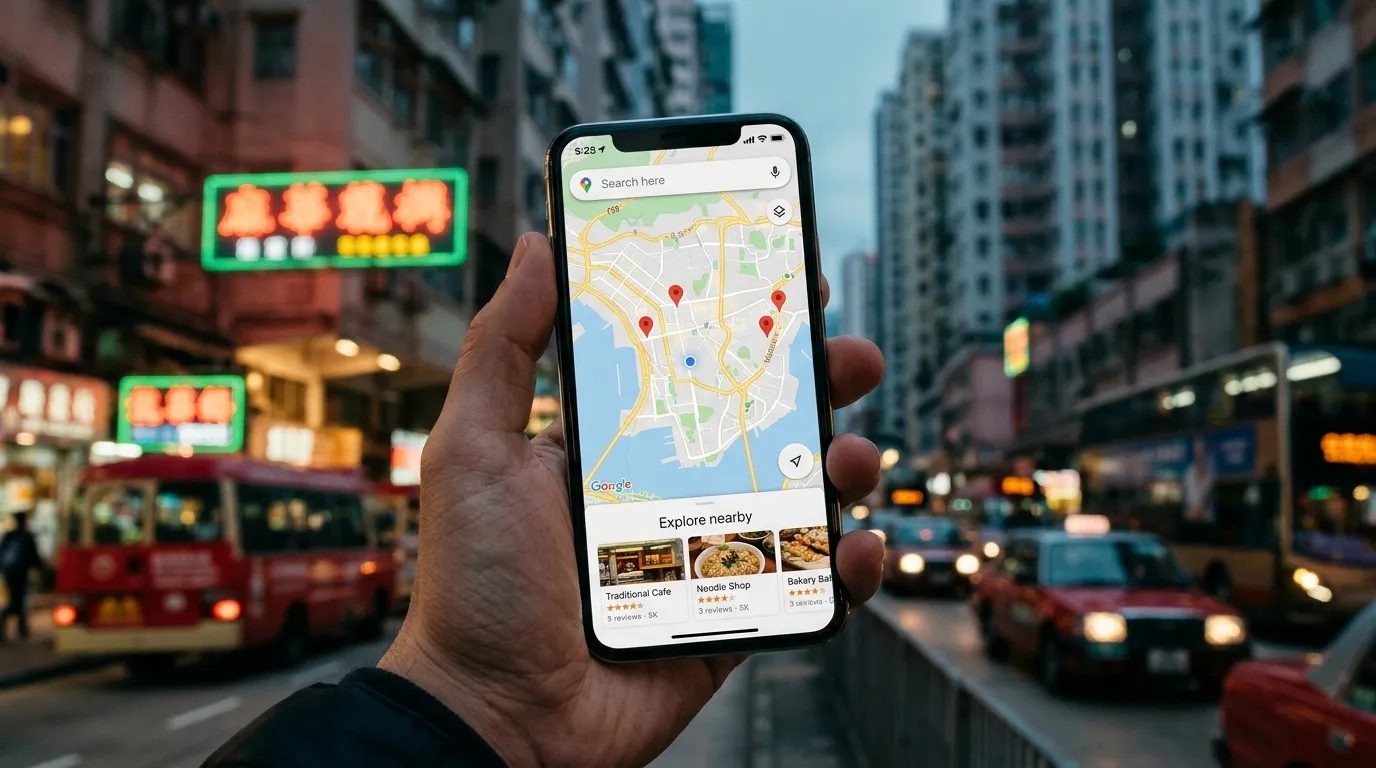
When someone in Causeway Bay types "dentist near me" or "best dim sum Sheung Wan" into Google, they rarely scroll. They look at the map, scan the three businesses listed underneath it, and tap one. That small box, the Google Map Pack, is where most local customers in Hong Kong are won or lost.
The good news is that the Map Pack is not reserved for chains with big budgets. It rewards businesses that give Google complete, consistent and trustworthy information, and that keep earning proof from real customers. This guide shows you exactly how local SEO in Hong Kong works, what decides who shows up in the Map Pack, and a step-by-step plan to get your business there.
What is local SEO and the Google Map Pack?
Local SEO is the process of making your business visible when people search for products or services near them. It covers your Google Business Profile, your website, your online reviews and the mentions of your business across the web.
The Google Map Pack (also called the Local Pack) is the block of three business listings that appears with a map for searches with local intent, such as "accountant Tsim Sha Tsui", "gym near me" or "aircon repair Kowloon". Each listing shows your star rating, review count, opening hours, distance and buttons to call, get directions or visit your website.
Because the Map Pack sits above the regular organic results on most local searches, it captures a large share of clicks and calls. For a restaurant, clinic, salon, studio, retailer or professional firm, ranking in it often matters more than ranking first in the organic results below.

Why local SEO matters so much in Hong Kong
Hong Kong is one of the most competitive local search markets in the world. A few realities make local SEO especially powerful here:
- Density. In districts like Mong Kok, Wan Chai or Central, dozens of businesses offering the same service can sit within a few hundred metres. Google has to pick three, and small signals decide which.
- Mobile-first behavior. People search on the move, on the MTR, between meetings, at lunch. Mobile searches with local intent turn into calls, WhatsApp messages and walk-ins quickly.
- Two languages, one market. Customers search in English, Traditional Chinese and even Cantonese romanization. Most competitors only optimize for one, which leaves a gap you can take.
- Building-level addresses. Many businesses operate from upper floors of commercial towers. Without a precise, verified listing, customers simply can't find the shop door, and Google is less confident sending them there.
How Google ranks the Map Pack
Google states that local results are based mainly on three things: relevance, distance and prominence. Understanding each one tells you where to focus.
| Factor | What it means | How you influence it |
|---|---|---|
| Relevance | How well your listing matches what the person searched for | Accurate primary and secondary categories, services, products, a keyword-aware description and a matching website page |
| Distance | How far your business is from the searcher or the location in the query | A correct, verified address and map pin; district landing pages; service areas for businesses that travel to customers |
| Prominence | How well known and trusted your business is, online and offline | Review quantity, quality and recency; citations on Hong Kong directories; local links and press; strong organic SEO |
You can't move your shop closer to every customer, so the winning strategy is to max out relevance and prominence. That is what the rest of this guide covers.
Step 1: Optimize your Google Business Profile
Your Google Business Profile is the single most important asset in local SEO in Hong Kong. Treat it like a second homepage, not a form you filled in once. Work through this checklist:
- Claim and verify the profile, and remove any duplicate listings for the same location.
- Use your real business name exactly as it appears on your signage. Stuffing keywords or district names into the name can get the profile suspended.
- Choose the most specific primary category (for example "Cosmetic dentist" rather than "Dentist" if that is your main service), then add relevant secondary categories.
- Enter a precise address including building name, floor and unit, and check that the map pin sits on the right building.
- Add a local phone number and your website link. If customers mostly reach you on WhatsApp, make that clear in your description and posts.
- Set accurate hours, including special hours for public holidays, Lunar New Year and typhoon signal closures.
- List services and products with short descriptions and prices where possible. These add relevance for long-tail searches.
- Upload real photos regularly: storefront, building entrance, interior, team and work. Photos of the lobby and lift help upper-floor businesses a lot.
- Publish Google Posts weekly or fortnightly with offers, news and events to show the profile is active.
- Seed and answer Q&A such as "Which MTR exit is closest?" and "Do you accept Octopus?"

Step 2: Win bilingual searches in English and Traditional Chinese
This is where many Hong Kong businesses quietly lose rankings. A customer might search "physiotherapy Wan Chai", "灣仔物理治療" or "wan chai physio". Google needs evidence that your business is relevant to all three.
- Research keywords in both languages. Check what people actually type in Traditional Chinese, not a literal translation of your English keywords. Hong Kong users often mix languages and use local terms.
- Show your Chinese business name. If you have an official Chinese name, use it consistently on signage, your website and directories so Google connects it to your listing.
- Build a Traditional Chinese version of your website with proper
hreflangtags, not machine-translated pages. Your key service and location pages need native-quality copy. - Encourage reviews in both languages. Reviews written in Chinese naturally contain the words Chinese-speaking customers search for.
- Use both languages in posts and Q&A where it fits your audience.
Bilingual local SEO is one of the clearest competitive advantages in Hong Kong. Most competitors optimize for one language and leave the other half of the market to you.
Step 3: Reviews, the fastest lever you control
Reviews influence both rankings (prominence) and clicks (people choose the listing with more and better reviews). What matters is not only your average rating, but how many reviews you have, how recent they are and whether you respond.
- Ask every happy customer. Create a short review link from your profile and share it on receipts, table cards, QR codes at the counter and in WhatsApp follow-up messages.
- Make it a routine, not a campaign. A steady flow of new reviews each month looks more natural and keeps your listing fresh.
- Reply to every review, positive or negative, within a few days. Thank people by name and mention the service naturally.
- Handle negative reviews calmly. Apologize, take the conversation offline and fix the issue. Future customers read your reply more closely than the complaint.
- Never buy or gate reviews. Fake reviews and offering rewards for positive ratings break Google's policies and can lead to removed reviews or a suspended profile.
Step 4: On-page local SEO for your website
Your website feeds Google's understanding of your relevance and prominence. Strong organic SEO and strong Map Pack rankings go hand in hand.
- Create a page for each core service, and if you serve several districts, create genuinely useful location pages (for example "Interior design in Sai Kung") rather than copy-paste pages with a swapped place name.
- Put location keywords in the right places: title tags, H1s, meta descriptions, opening paragraphs and image alt text.
- Show your name, address and phone number (NAP) in the footer and on your contact page, matching your Google Business Profile exactly.
- Embed a Google Map and add directions that mention landmarks and MTR exits.
- Add LocalBusiness schema markup with your address, geo-coordinates, opening hours and links to your profiles.
- Make it fast and mobile-friendly, with a tap-to-call button and a WhatsApp button above the fold.

Step 5: Citations and local links in Hong Kong
A citation is any online mention of your business name, address and phone number. Consistent citations on trusted sites confirm to Google that your business is real and located where you say it is.
- Start with the big platforms: Apple Maps, Bing Places, Facebook and Instagram business pages, and LinkedIn for B2B firms.
- Add Hong Kong directories that fit your industry, such as OpenRice for restaurants and cafes, Yellow Pages Hong Kong, chamber of commerce and industry association listings, and booking platforms your customers already use.
- Keep NAP identical everywhere. Pick one format for your address (including floor and unit) in English and Chinese and use it consistently.
- Earn local links through partnerships with neighboring businesses, sponsorships, local events, community groups and coverage on Hong Kong lifestyle and business media.
Common local SEO mistakes Hong Kong businesses make
- Adding keywords or district names to the business name on Google Business Profile.
- Leaving old addresses or phone numbers live on directories after moving offices.
- Using a virtual office or co-working address you don't actually staff, which risks suspension.
- Ignoring the Chinese-language market, or relying on machine-translated pages.
- Collecting reviews in bursts, then going silent for months.
- Never updating photos, posts or holiday hours, so the profile looks abandoned.
- Sending Map Pack clicks to a slow homepage instead of a relevant service or location page.
How to measure your local SEO results
Local SEO should be tracked like any other growth channel. Check your Google Business Profile performance report monthly for searches, views, calls, website clicks and direction requests. In Google Analytics, tag your profile's website link with UTM parameters so you can see which visitors came from your listing. Track your Map Pack position for your top 10 to 20 keywords from different points across your target districts, because rankings change street by street. Most importantly, connect it all to calls, WhatsApp enquiries, bookings and revenue.
Final thoughts
Winning the Google Map Pack in Hong Kong comes down to consistency: a complete and active Google Business Profile, a website that clearly matches your services and locations, a steady stream of genuine reviews, and accurate information everywhere your business appears, in both English and Chinese. Do these well every month and you will steadily push past competitors who set up their listing once and forgot about it.
If you'd rather have specialists handle it, our SEO team runs local SEO for Hong Kong businesses from audit to rankings, and pairs it with paid search and performance marketing when you want results faster. Contact us for a free local SEO audit.